
US Amps USA-100HC Audio Testing Results: Classic High-Current Performance on the Bench
Author:
Douglas Bruce
Lead Audio Test Engineer and Technical Support, US Amps
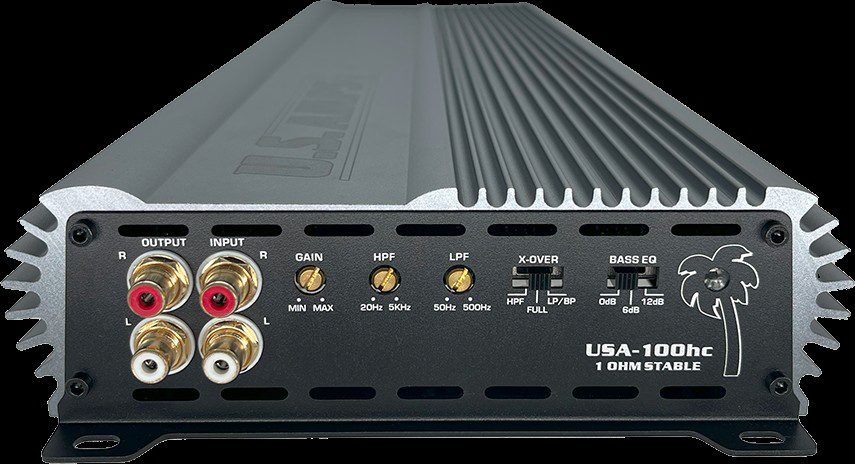
US Amps USA-100HC Audio Testing Results
There are amplifiers where the wattage number gets most of the attention.
Then there are amplifiers where the deeper measurements tell an even more interesting story.
The US Amps USA-100HC falls into that second category.
I recently put the 100HC through a series of controlled audio tests to examine not only its power capability, but also frequency response, distortion, signal-to-noise ratio, stereo separation, slew rate, output impedance, damping factor, and harmonic content.
The results give us a much more complete picture of what this high-current amplifier is actually doing.
Primary Test Conditions
The main audio performance testing was conducted at approximately 12.6 volts into a 4-ohm stereo load.
Measurements were taken at:
1 watt
10 watts
100 watts
Testing the amplifier at multiple output levels lets us see how its behavior changes as power increases instead of looking at only one operating point.
Frequency Response: 12 Hz to 32,000 Hz
Across every measured power level, the USA-100HC maintained a frequency response of:
12 Hz to 32,000 Hz ±2 dB
That measurement remained the same at 1 watt, 10 watts, and 100 watts.
The range extends well beyond the traditional audible spectrum on the high end while also reaching extremely low frequencies on the bottom end.
More importantly, the measured response remained consistent as amplifier output increased.
Extremely Low THD + Noise
One of the first measurements that stands out is the USA-100HC’s THD+N performance.
Minimum measured THD+N was:
1 watt: 0.02%
10 watts: 0.01%
100 watts: 0.04%
Maximum measured THD+N was:
1 watt: 0.05%
10 watts: 0.03%
100 watts: 0.15%
At the 10-watt test level, minimum THD+N dropped to just 0.01%.
Power is easy to talk about, but measurements like these are important because an amplifier’s job isn’t simply to make a signal larger. It needs to amplify that signal while adding as little unwanted information as possible.
Signal-to-Noise Ratio
Measured signal-to-noise ratio increased as output increased:
64.2 dB at 1 watt
72.2 dB at 10 watts
80.2 dB at 100 watts
At the 100-watt output level, measured SNR reached 80.2 dB under these test conditions.
As the desired audio signal becomes larger relative to the amplifier’s noise floor, the resulting SNR improves.
Stereo Crosstalk
Because the primary tests were conducted in stereo, we can also examine channel separation.
Stereo crosstalk measured:
-84 dB at 1 watt
-80 dB at 10 watts
-72 dB at 100 watts
The negative values indicate how far below the reference signal the unwanted signal from the opposite channel was measured.
That provides another piece of the overall picture when evaluating stereo amplifier performance.
165 V/µs Slew Rate
This is one of the measurements that really caught my attention.
The USA-100HC produced a measured slew rate of:
165 V/µs
And it maintained that measurement at all three tested output levels.
1 watt: 165 V/µs
10 watts: 165 V/µs
100 watts: 165 V/µs
Slew rate represents how quickly the amplifier’s output voltage can change in response to the incoming signal.
Music is dynamic. Transients happen quickly, and an amplifier needs the ability to follow those changes.
The fact that the 100HC maintained the same measured 165 V/µs across all three test levels is worth highlighting.
Output Impedance and Damping Factor
The USA-100HC also measured extremely low output impedance.
At 1 and 10 watts:
0.004848 ohms
At 100 watts:
0.005100 ohms
Those measurements corresponded with damping factors of:
825 at 1 watt
825 at 10 watts
784 at 100 watts
A damping factor of more than 800 at the lower test levels is a substantial measurement.
Damping factor is related to the relationship between the amplifier’s output impedance and the connected loudspeaker load. Lower amplifier output impedance generally gives the amplifier greater electrical authority over the speaker.
This becomes especially interesting with high-current amplifier designs where speaker control is an important part of the performance equation.
FFT Harmonic Analysis
The next portion of testing used a Fast Fourier Transform, or FFT, to look directly at harmonic content.
The reference signal was:
40 Hz at 0 dB
At 1 watt, the second harmonic at 80 Hz measured:
-75 dB
The third harmonic at 120 Hz was significantly lower:
-110 dB
At 10 watts:
Second harmonic: -71 dB
Third harmonic: -98 dB
At 100 watts:
Second harmonic: -62 dB
Third harmonic: -85 dB
The FFT results help us see where distortion components are occurring instead of reducing amplifier behavior to a single THD percentage.
In particular, the third-harmonic measurements remained far below the fundamental across all three tested levels.
Now Let’s Talk About Power
For the power-over-frequency testing, the amplifier was configured into a:
2-ohm mono load
Testing was conducted at a minimum of:
12.0 volts
with output measured at approximately:
0.5% THD
Rather than taking one wattage measurement at one convenient frequency, the amplifier was tested from 10 Hz through 60 Hz.
The results:
| Frequency | Continuous Power |
|---|---|
| 10 Hz | 2,999 watts |
| 20 Hz | 3,172 watts |
| 30 Hz | 3,175 watts |
| 40 Hz | 3,191 watts |
| 50 Hz | 3,190 watts |
| 60 Hz | 3,195 watts |
At 40 Hz, the USA-100HC produced 3,191 watts.
At 50 Hz:
3,190 watts
And at 60 Hz:
3,195 watts
That’s only a 5-watt variation from 40 Hz through 60 Hz.
Even at 20 Hz, the amplifier produced 3,172 watts, only 23 watts below the highest measurement recorded during the sweep.
And all the way down at 10 Hz, it still produced:
2,999 watts.
That’s the advantage of looking at power over frequency instead of focusing on one isolated number.
How the Testing Was Conducted
For this test, I also documented the methodology so the results could be understood in context.
Testing was performed on May 23, 2026 at a room temperature of approximately 70°F.
The amplifier was supplied by an AGM battery bank.
A one-hour cooldown period was allowed between each test run.
The final measurements were averaged across three runs.
Power connections were made using a two-foot run of tinned OFC 1/0 cable.
Maximum power was held for five continuous seconds during testing.
Those details matter.
Voltage, wiring, load, temperature, test duration, and recovery time can all influence amplifier measurements. Documenting those conditions gives us a much better reference point for understanding the numbers.
The Numbers Tell the Story
The USA-100HC is a great example of why we want to look beyond a single amplifier specification.
Yes, it produced nearly 3,200 watts into the tested 2-ohm mono load.
But look at everything happening around that number.
A measured frequency response extending from 12 Hz to 32 kHz.
Minimum THD+N reaching 0.01%.
A consistent 165 V/µs slew rate.
Output impedance below 0.005 ohms at the lower test levels.
A measured damping factor reaching 825.
And power remaining remarkably consistent as frequency changed.
Those measurements give us a much better understanding of the amplifier than a wattage rating alone ever could.
This is exactly why we’re continuing to put US Amps products on the bench and publish the results.
We aren’t interested only in telling you what an amplifier is supposed to do.
We want to measure what it actually does.
— Douglas Bruce
Lead Audio Test Engineer and Technical Support
US Amps