
US Amps Impact 100.4 Audio Testing Results
US Amps Impact 100.4 Audio Testing Results: On the Bench with Douglas Bruce
Author:
Douglas Bruce
Lead Audio Test Engineer and Technical Support, US Amps
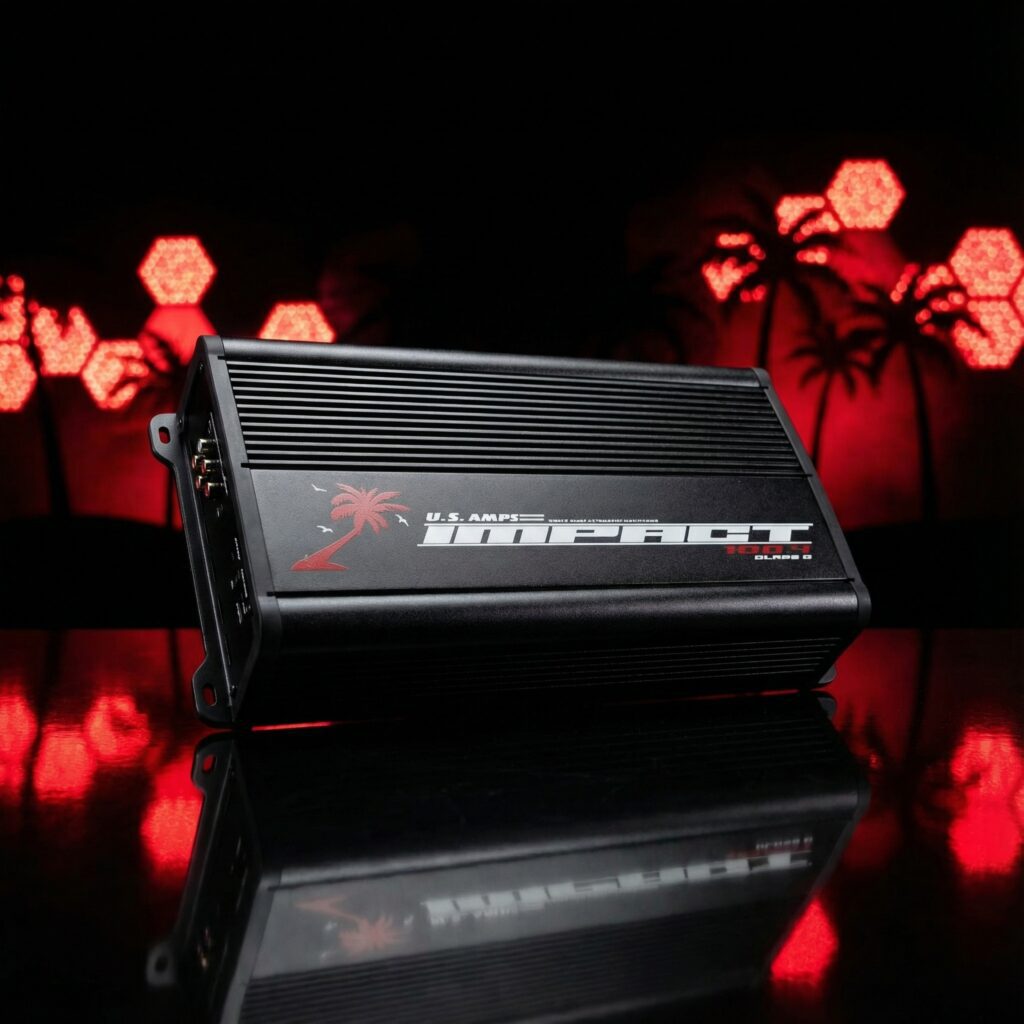
When evaluating an amplifier, there is much more to the story than simply asking how many watts it produces.
Power matters, but so do frequency response, distortion, noise, channel separation, damping, slew rate, and how consistently the amplifier can deliver power across the frequencies it will actually reproduce in a vehicle.
I recently put the US Amps Impact 100.4 through a series of audio performance tests to take a closer look at exactly how this amplifier behaves on the bench.
The goal wasn’t simply to generate another power number. I wanted to examine the amplifier from an audio performance standpoint and establish measurable data that tells us more about what is happening to the signal as power increases.
Test Conditions
The primary audio performance measurements were conducted with the amplifier operating at approximately 12.6 volts into a 4-ohm stereo load.
Measurements were taken at three different output levels:
1 watt
10 watts
100 watts
Testing an amplifier at several output levels is important because an amplifier’s behavior can change considerably as output increases. Looking at multiple power levels gives us a much better picture of its overall performance than a single measurement.
Frequency Response: 20 Hz to 22,000 Hz
Across all three tested output levels, the Impact 100.4 produced a measured frequency response of:
20 Hz to 22,000 Hz ±2 dB
That result remained consistent at 1 watt, 10 watts, and 100 watts.
This is important because we want an amplifier to reproduce the incoming audio signal consistently as output increases. An amplifier isn’t doing its job properly if its tonal response changes dramatically simply because the volume goes up.
The Impact 100.4 maintained its measured response throughout the test range.
Total Harmonic Distortion + Noise
THD+N gives us a way to examine unwanted distortion and noise in relation to the original signal.
The minimum measured THD+N decreased as output increased:
1 watt: 0.5%
10 watts: 0.2%
100 watts: 0.1%
Maximum measured THD+N during the tests was:
1 watt: 0.6%
10 watts: 0.6%
100 watts: 0.8%
These measurements help show how the amplifier behaves at realistic operating levels instead of evaluating it exclusively near maximum output.
Signal-to-Noise Ratio
One of the more interesting measurements was the improvement in signal-to-noise ratio as amplifier output increased.
Measured SNR was:
65.5 dB at 1 watt
74.2 dB at 10 watts
83.2 dB at 100 watts
As the desired audio signal becomes larger relative to the amplifier’s noise floor, the measured signal-to-noise ratio improves.
At 100 watts, the Impact 100.4 reached a measured 83.2 dB SNR under these test conditions.
Stereo Crosstalk
Channel separation remained extremely consistent throughout the testing.
Stereo crosstalk measured:
55.2 dB at 1 watt
55.2 dB at 10 watts
55.5 dB at 100 watts
Consistency here is a good sign. We don’t want channel interaction increasing significantly as amplifier output rises.
Slew Rate
Measured slew rate was:
24 V/µs at 1 watt
24 V/µs at 10 watts
22 V/µs at 100 watts
Slew rate describes how quickly an amplifier’s output can respond to a changing input signal.
Music is constantly changing. Transients, percussion, vocals, and other complex musical information require the amplifier to rapidly follow those changes.
The Impact 100.4 remained very consistent across the three measured output levels.
Output Impedance and Damping Factor
The measured output impedance was approximately:
0.0266 ohms
The amplifier also maintained a measured damping factor of:
150
across the tested output levels.
Damping factor is particularly interesting in loudspeaker applications because it relates to the amplifier’s ability to electrically control the connected speaker.
A loudspeaker isn’t simply a passive load. Once its cone and voice coil begin moving, the speaker itself can generate electrical energy. Maintaining a low amplifier output impedance helps the amplifier maintain control of that movement.
Looking Deeper with FFT Analysis
Power and distortion percentages tell us part of the story, but a Fast Fourier Transform, or FFT, lets us look deeper into the actual harmonic content being produced.
For this test, a 40 Hz fundamental signal at 0 dB was used as the reference.
The second harmonic at 80 Hz measured:
-66 dB at 1 watt
-62 dB at 10 watts
-55 dB at 100 watts
At lower power levels, the third harmonic at 120 Hz measured:
-90 dB at 1 watt
-84 dB at 10 watts
The complete laboratory results include the remaining harmonic measurement at the 100-watt test point.
FFT testing is useful because instead of simply telling us that distortion exists, it allows us to examine where that additional harmonic energy is appearing relative to the original test signal.
That gives us a much more complete look at amplifier behavior.
Power Across Frequency
I also wanted to see something that often gets overlooked during amplifier testing:
Does the amplifier produce similar power at different frequencies?
For this portion of testing, the Impact 100.4 was tested into a 4-ohm mono load at a minimum 12.6 volts, with output measured at approximately 0.5% THD.
The results were:
| Frequency | Continuous Power |
|---|---|
| 10 Hz | 290 watts |
| 20 Hz | 305 watts |
| 30 Hz | 340 watts |
| 40 Hz | 362 watts |
| 50 Hz | 361 watts |
| 60 Hz | 361 watts |
The amplifier reached its highest measured output at 40 Hz with 362 watts, and remained essentially there at 50 and 60 Hz with 361 watts.
That means from 40 through 60 Hz, output varied by only about one watt during this test.
Even at 20 Hz, the amplifier produced 305 watts, while the extremely low 10 Hz test still resulted in 290 watts of continuous output.
Those numbers give us a much better picture of the amplifier’s low-frequency performance than a single power measurement taken at one frequency.
More Than a Wattage Number
This is exactly why we perform this type of testing at US Amps.
A wattage rating by itself doesn’t tell you how an amplifier handles the audio spectrum. It doesn’t tell you about its noise floor, channel separation, harmonic behavior, output impedance, damping factor, or whether its frequency response changes as output increases.
The Impact 100.4 maintained a measured 20 Hz to 22 kHz frequency response across all three tested power levels, reached an 83.2 dB signal-to-noise ratio at 100 watts, maintained a 150 damping factor, and produced as much as 362 watts continuously into the tested 4-ohm mono load at 12.6 volts.
Those are the measurements.
And that’s ultimately what we’re interested in at US Amps: not simply what an amplifier is supposed to do, but what it actually does when we put it on the test bench.
— Douglas Bruce
Lead Audio Test Engineer and Technical Support
US Amps